Start with a targeted pilot project
Avoid the temptation to automate everything at once; begin with a single, high-impact workflow to prove ROI and refine your implementation process.
Custom AI solutions
Learn how to implement practical custom AI solutions for business. A step-by-step guide to workflow automation, intelligent assistants, and internal tools.
Generic AI tools often fall short when addressing the unique operational complexities of established businesses. Custom AI solutions go beyond standard automation, building tailored systems that integrate directly into your existing infrastructure to handle your specific document processing, data extraction, and internal workflows. By focusing on bespoke logic rather than broad capabilities, these systems deliver measurable ROI through increased efficiency and reduced human error.
Implementing custom AI requires a methodical approach that balances innovation with business stability. It is not about deploying the latest model, but about creating reliable, scalable tools that solve defined problems. Whether you are automating repetitive data entry or building an intelligent assistant tailored to your company's knowledge base, success is rooted in clear objectives, high-quality data, and iterative development.
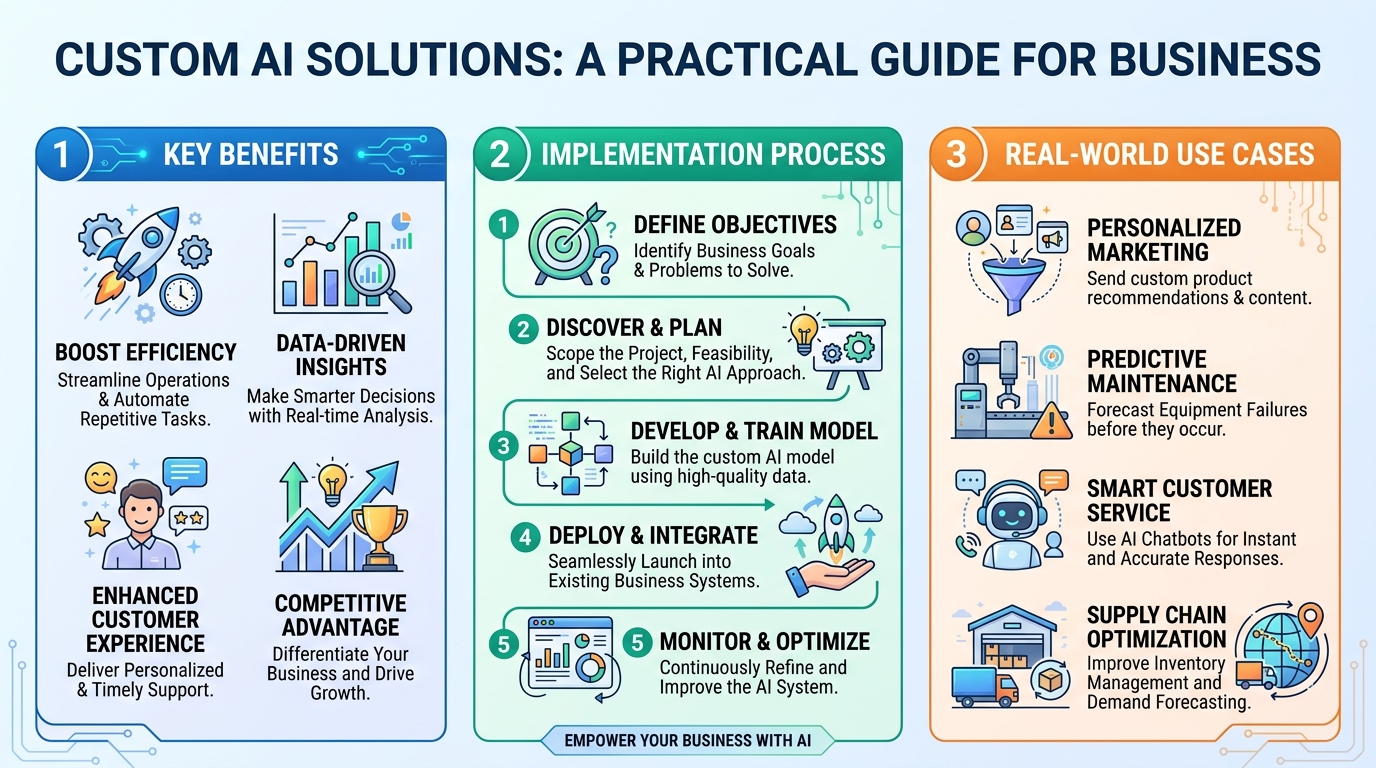
Start by auditing your daily operations to pinpoint high-volume, repetitive tasks that drain employee time. Focus on areas involving structured data, document workflows, or information retrieval where consistency is often compromised by manual effort.
Your AI is only as effective as the data it utilizes. Assess whether your current data is clean, accessible, and structured enough to support an AI model, as poor data quality is the most common cause of implementation failure.
Establish clear metrics for success before development begins, such as reducing processing time by a specific percentage or lowering error rates. Having defined benchmarks allows you to measure the actual business impact once the system is deployed.
Ensure the proposed solution is designed to plug directly into your current tech stack rather than creating a siloed environment. Prioritize seamless API integrations with your existing CRM, ERP, or communication platforms to ensure smooth adoption.
Develop a Minimum Viable Product (MVP) to test the core functionality within a controlled setting. Use this phase to gather user feedback and iterate on the model's accuracy before rolling it out to the wider organization.
Post-deployment, maintain a continuous feedback loop to monitor system performance and handle edge cases. Regular fine-tuning ensures the AI adapts to evolving business needs and maintains high performance over time.
Avoid the temptation to automate everything at once; begin with a single, high-impact workflow to prove ROI and refine your implementation process.
Ensure your custom AI architecture is built with strict data privacy and governance protocols, especially when handling sensitive customer or proprietary business information.
Design your AI to support your team, not replace them, by including human verification steps in critical workflows where accuracy is non-negotiable.
Turn a business workflow into a working AI product without a long agency process.
Ready to build? Get in touch