Prioritize Data Security
Ensure your custom AI provider adheres to strict data privacy standards like SOC2 or GDPR to protect your proprietary information during processing.
Custom AI solutions
Learn the practical steps to implement custom AI for your business, from goal setting and data readiness to secure integration and scaling your operational efficiency.
Integrating artificial intelligence into business operations is no longer just about adopting off-the-shelf software; it is about developing bespoke systems that address specific operational bottlenecks. Generic AI tools often fall short when faced with proprietary data formats, unique industry compliance standards, or complex internal workflows. A custom AI solution bridges this gap by aligning machine learning models and automation engines directly with your existing infrastructure and business logic.
Developing custom AI involves more than writing code; it requires a systematic approach to data governance, process architecture, and integration security. Whether your goal is to automate document processing, build an intelligent assistant for your team, or create a predictive data extraction layer, a tailored build ensures that the technology serves your specific business outcomes rather than forcing your workflows to adapt to the limitations of standard SaaS products.
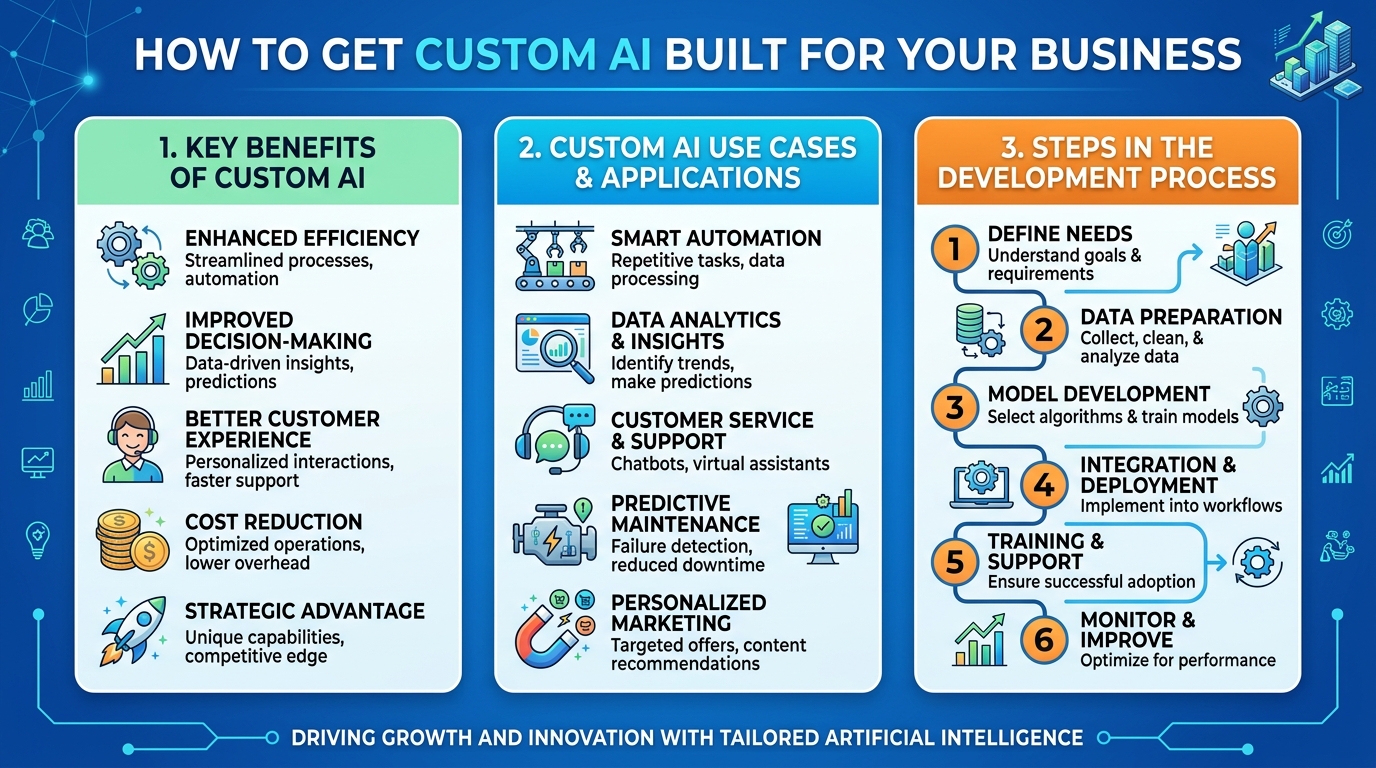
Begin by identifying the exact business process or bottleneck you intend to solve. Rather than seeking a generic 'AI implementation,' focus on measurable outcomes such as reducing manual data entry time or accelerating response times for internal queries.
Assess the quality and accessibility of the data your business currently generates. Custom AI models require clean, structured, and securely accessible datasets to function accurately and reliably within your environment.
Collaborate with developers to evaluate if current AI capabilities can realistically address your requirements. This phase determines whether the solution should be built using large language models, predictive analytics, or specialized automation scripts.
Avoid high-cost, full-scale rollouts by first building a Minimum Viable Product (MVP) that targets a single, high-impact function. This step allows you to validate system performance and user adoption rates before committing to wider deployment.
Deploy the validated AI solution into your production environment using secure APIs and existing internal software. Continuously monitor the system's performance and iterate based on real-world usage data to ensure accuracy.
Ensure your custom AI provider adheres to strict data privacy standards like SOC2 or GDPR to protect your proprietary information during processing.
Evaluate potential solutions based on cost-savings or efficiency gains rather than technical sophistication; simple automation often delivers better value than complex neural networks.
AI systems require ongoing monitoring and retraining to maintain accuracy; factor long-term support and system updates into your budget from the beginning.
Turn a business workflow into a working AI product without a long agency process.
Ready to build? Get in touch