Prioritize Integration Over Replacement
Choose AI solutions that connect to your current CRM, ERP, and project management tools, ensuring your team isn't forced to learn an entirely new software ecosystem.
Custom AI solutions
Learn how to implement custom AI in your small business. Discover our step-by-step approach to automating workflows and boosting efficiency with CustomSolutions.ai.
Implementing artificial intelligence is no longer exclusive to large enterprises with unlimited budgets. For small businesses, the path to AI adoption lies in identifying repetitive, data-heavy bottlenecks—such as manual document processing, customer support triage, or fragmented data entry—and deploying targeted systems to solve them. Unlike generic off-the-shelf software, custom AI solutions are tailored to your specific workflows, ensuring they integrate seamlessly with the tools your team already uses daily.
At CustomSolutions.ai, we focus on building practical, reliable AI infrastructure that works as an extension of your workforce. By automating high-friction tasks and intelligently processing your business data, we help you reduce operational overhead and scale efficiently. Our approach prioritizes security, scalability, and measurable outcomes, allowing you to modernize your operations without the complexity of managing large-scale technical deployments.
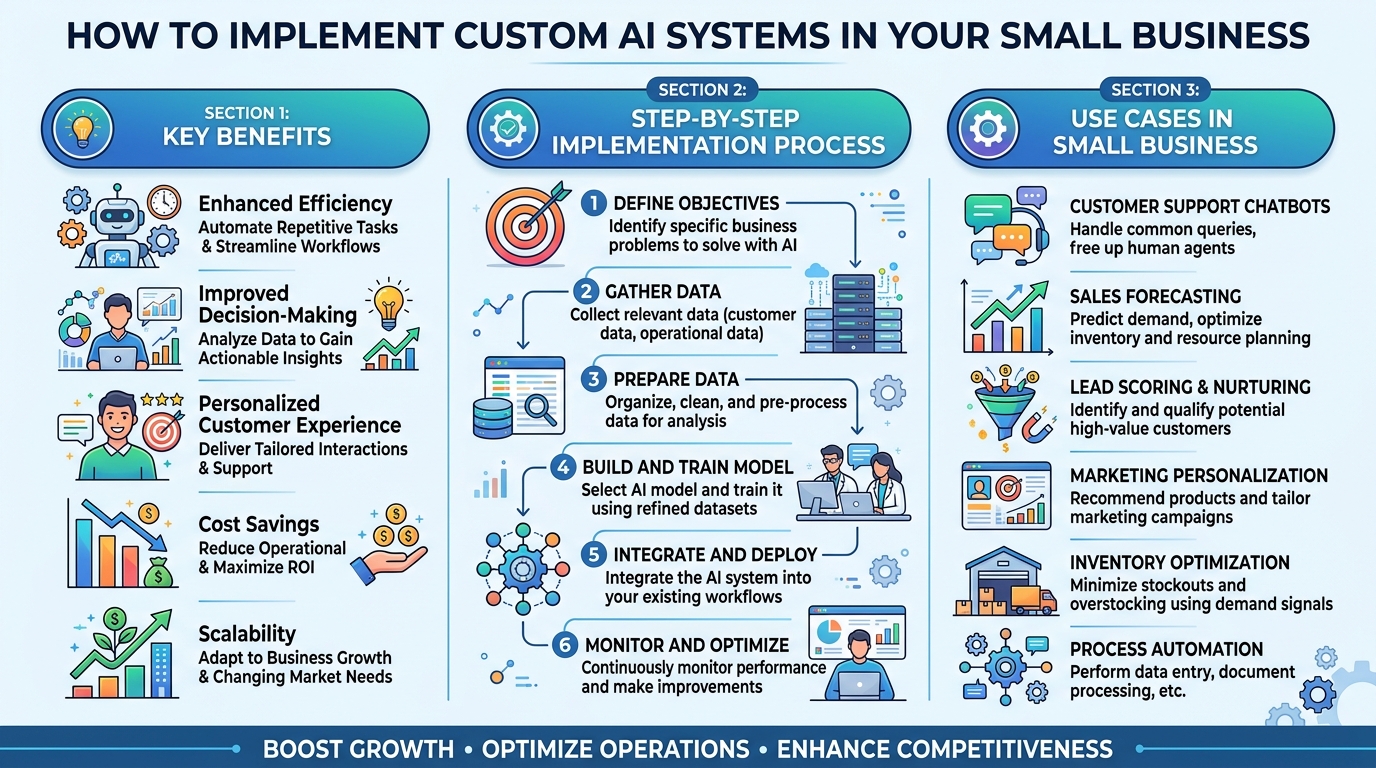
Begin by identifying the most time-consuming or error-prone tasks in your business that rely on structured data. Focus on areas like customer inquiries, document routing, or internal reporting where manual intervention is currently the primary constraint.
Establish clear objectives for what the AI system must achieve to be considered successful. Whether the goal is to reduce ticket resolution time by 50% or automate 80% of data extraction from incoming invoices, specific KPIs are essential for tracking ROI.
Ensure your business data is accessible, organized, and secure, as the quality of your AI outputs depends directly on the quality of your input data. Our team will assess your current data architecture to ensure it is structured effectively for training and model interaction.
We map out a custom architecture that integrates with your existing tech stack rather than replacing it. We build a functional prototype to validate the model's performance on your actual business workflows, ensuring it handles real-world complexity.
After the pilot phase, we perform iterative testing to refine accuracy and edge-case handling. Once deployed, we provide the necessary guidance to ensure your team is comfortable utilizing the new system and can manage it effectively day-to-day.
AI systems require ongoing monitoring to maintain high performance as business conditions evolve. We continuously analyze usage patterns to optimize the system, ensuring it scales alongside your growth and continues to deliver value.
Choose AI solutions that connect to your current CRM, ERP, and project management tools, ensuring your team isn't forced to learn an entirely new software ecosystem.
Avoid the trap of trying to automate everything at once; launch with a single, high-frequency task to build momentum and prove internal value quickly.
When implementing custom AI, ensure your vendor uses data isolation practices so that your sensitive business information is never used to train public, open-source models.
Turn a business workflow into a working AI product without a long agency process.
Ready to build? Get in touch