Start with focused pilots
Don't attempt to automate everything at once; start by solving a single, well-defined problem to demonstrate immediate value.
Custom AI solutions
Reduce operational overhead with custom AI automation. Learn how to identify, build, and deploy tailored AI systems to lower costs and boost productivity.
Operational inefficiencies often stem from repetitive, manual tasks that drain resources and inflate overhead. Businesses frequently struggle with data silos, slow document processing, and fragmented workflows that hinder productivity and increase human error. Custom AI automation transforms these bottlenecks by integrating intelligent software directly into your existing infrastructure to handle routine processes autonomously.
A practical custom AI solution involves auditing your current operational friction points and deploying targeted systems—such as intelligent document processing, automated customer support assistants, or data extraction pipelines—that function without constant human oversight. Unlike off-the-shelf software, these systems are engineered specifically for your unique data sets and business rules, ensuring that technology serves your specific workflow requirements rather than forcing your team to adapt to rigid, pre-built tools.
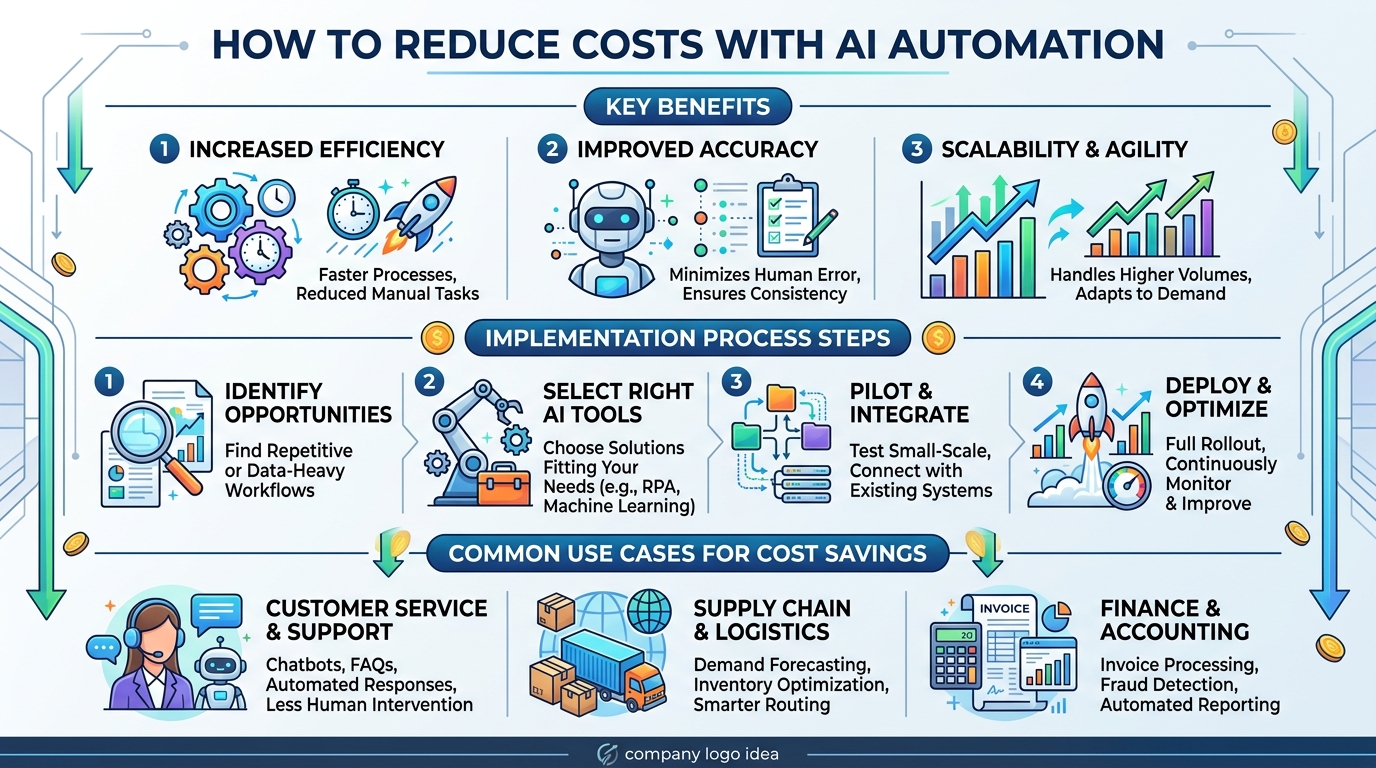
Start by auditing your internal processes to pinpoint tasks that are repetitive, rule-based, and time-consuming. Focus on areas where data entry, categorization, or status updates occupy significant employee hours.
Establish clear benchmarks for what success looks like, such as a reduction in processing time per ticket or a decrease in manual data entry errors. Quantifying these goals helps determine the ROI of the potential automation solution.
Evaluate the quality and accessibility of the data your current systems generate. AI systems perform best when they have clean, structured inputs, so identify any data preparation required before development begins.
Work with engineers to architect a system that integrates seamlessly with your existing tech stack. This ensures that the new AI components communicate correctly with your CRM, ERP, or other critical business software.
Build a minimum viable version of the automation to test its effectiveness in a controlled environment. Use this pilot phase to refine the model's accuracy and ensure it handles edge cases correctly before a full-scale deployment.
Don't attempt to automate everything at once; start by solving a single, well-defined problem to demonstrate immediate value.
Ensure your custom AI tools plug directly into your current software ecosystem rather than creating another standalone platform to manage.
A robust automation plan should always define how the system flags and escalates complex or ambiguous tasks to human staff.
Turn a business workflow into a working AI product without a long agency process.
Ready to build? Get in touch